Noted molecular
biologist, Bruce Lipton in his seminal work, The Biology of Beliefs has argued
that we are not prisoners to our genes. By directing our mind on new pathways
and developing an empowering belief system we can recreate ourselves even at
DNA level
 The latest
research in the field of neuroplasticity indicate that the brain is capable of
changing its function in response to your environment, thinking, emotions,
behaviour, as well as injury.

Similarly, Dr
Jeffery M Schwartz in his book, The mind and the brain suggests that you
play an active role in influencing brain function by deciding where to
focus your attention. He contends that mind and brain are not same and people
are able to consciously change their brain functioning with proper attention
and effort.
The latest
research in the field of neuroplasticity indicate that the brain is capable of
changing its function in response to your environment, thinking, emotions,
behaviour, as well as injury.
Now, we know
that the brain remains neuroplastic for life. Self-directed
neuroplasticity allows us to consciously
control how we want our brains to work. In other words, if you want your brain
to become better in social situations, you’d “force” yourself to become more
comfortable in these situations and your brain eventually adapt. Similarly,
anytime you learn a new skill (e.g. how to play guitar), your brain functioning
changes and adapts to whatever you put in front
Indian Sages knew
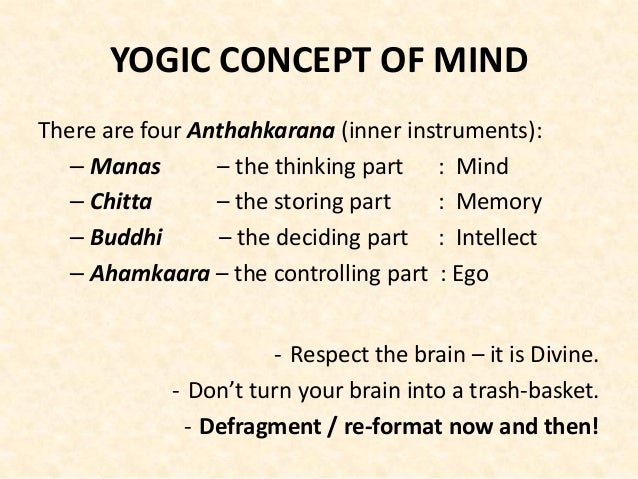
long back that the “mind” is responsible
for controlling the brain. They knew that the intangible ( mind) creates the
tangible (brain). That is why, in the traditional Indian lifestyle a lot of
emphasis has been made on purification of mind through focus, diet and goal
setting. A purified and controlled mind is considered as the foundation of a
fulfilling life.
On a broad based level, brain is the hardware
and mind is the software to run the most complex machine of this universe, the
human body. The higher order areas allow you to refocus your attention and
utilize willpower to alter your behaviour, which in turn creates changes within
your brain (i.e. neuroplasticity).
Research
suggests that through specific tools, the idea of neuroplasticity can be activated
in any brain. Some the key tools in this regard are
1.
Attention: Any object can
catch your attention at any given moment in time, that’s just the by-product of
exposing your brain to various stimuli. However, you have full control over the
amount of attention to which you give a particular object, thought, or
behaviour. You could have a depressing thought and give it a lot of attention
(further magnifying it), or you could choose to let it pass and refocus on
something else. The goal is to pay attention to the ideas you want in order to
make your brain “light up” and rewire the way you want.
2.
Willpower: Simply paying
attention is great, but attention alone won’t really change anything. You need
to actually go down in the trenches and put in some work. If you are trying to
change a particular behaviour such as engaging in compulsive behaviour, come up
with a plan to refocus your attention, and partake in a different activity to
change the way your brain is firing. With consistent practice, your brain will
begin to fire up the circuits associated with the new activity rather than the
unwanted one. Willpower is your ability to not to focus on stimuli which is not
good for your goals and aspirations.
3.
Practise (“You Don’t Use It, You Lose It”): Regions within your brain are constantly in
competition for carrying out various functions. Whichever regions that you use
more often, will effectively overpower the other regions and get more neural
real-estate. The regions and neural pathways that you use less frequently will
get less real-estate and may get minimized and/or eventually die down. Your
daily habits make a big impact on your brain functioning because the neural
pathways required to carry out those habits become strengthened in time, and
those used less often get weaker.
4.
Awareness: Become aware of what you’d like to change. You may
be aware of a variety of things that you’re unhappy with and/or things in your
life that you dislike. Pick one thing at a time and become aware of the
particular habit, mood, etc. that you’d like to change. Within the space of
expanded awareness, we need to know our DOs and DoNTs. This list should always
be ready with us and we should keep of upgrading the same with new experiences
of life.
The above path
is easier said than done. Unwanted external stimuli, will again and again take
your thoughts to the regressive domain of oozing control. The subconscious mind
also need to be trained well to fully exploit the potential of neuroplasticity.
The below indicated tools are pretty useful for harnessing the power of
subconscious.
•
Meditation: The act of meditating helps regain control of your
attention. Without controlling your attention, self-directed neuroplasticity is
useless. The greater the degree to which you develop your attention, the less
you are an automaton or at the mercy of your pre-existing neural patterns.
Certain forms of meditation can be used to create specific changes in the way
the brain works; long-term meditators have significantly different brain waves and activation
than non-meditators.
•
Mindfulness: The practice of mindfulness helps you become more
aware of your thinking as well as your behaviours. It is an act of seeing the
subject reality of life. It allows you to be mindful of how your brain is
currently working as well as with refocusing your attention should you want to
change a particular destructive behaviour. Some consider “mindfulness” as
“Vipassana” meditation, but may simply consider it a way to consciously alter
your perspective.
•
Visualization: The practice of visualization can create changes in
the brain as well. In some studies, it was found that visualizing playing an
instrument or engaging in a behaviour produced the same brain change as
actually doing the behaviour. The thing with visualization is that it’s
relatively difficult for some people to get specific enough and/or accurate
enough to produce the same brain change
The final
outcome totally depends on the particular activity that you are attempting to
learn, your personal motivation for making the change, as well as the degree of
the change you plan to make. Passion or personal motivation to overcome a
particular problem plays a key role in dictating the degree of difficulty it
takes to change the brain. The more you really want to change, the more effort
you are going to make in order to get over the hump. Passion is what separates
the people who get results and change from the people who stagnate in the same
neural “ruts.”
************
Comments
Post a Comment